

THE HAKKA JOURNAL
Bone Saw Machine Review for Commercial Kitchens
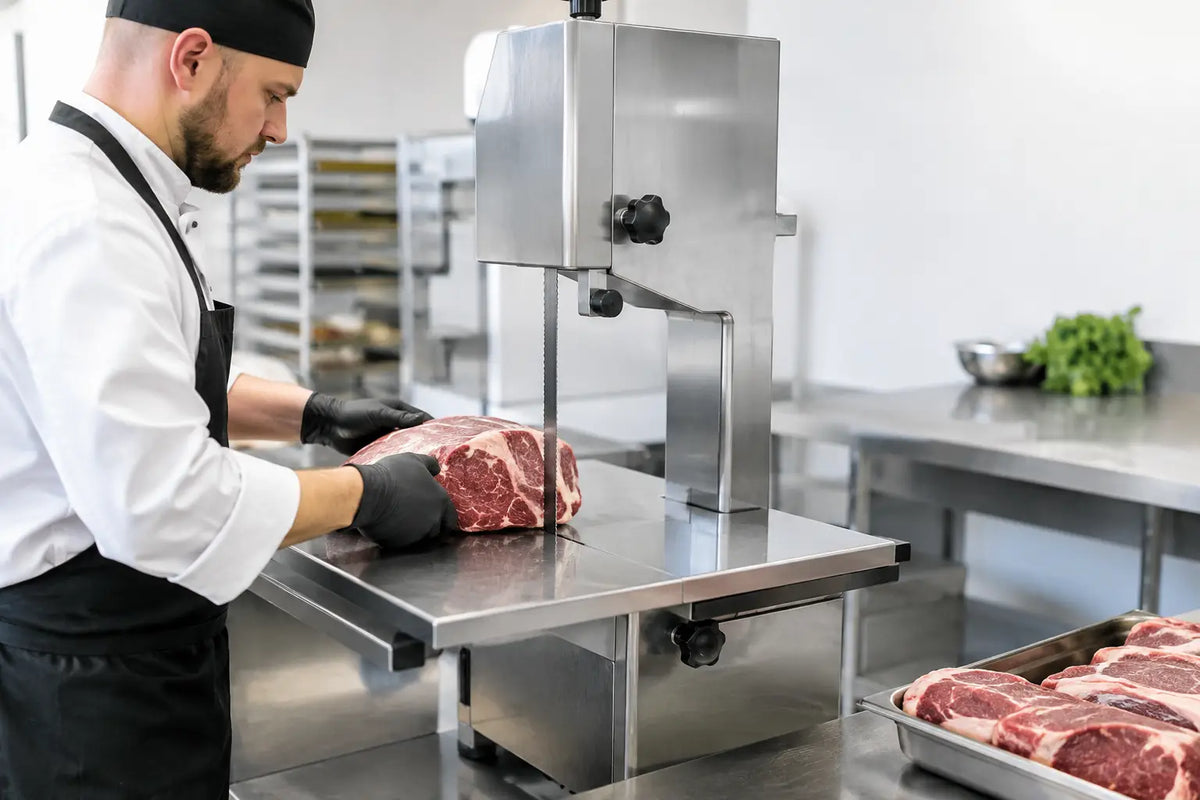
A bone-in pork loin, frozen rib section, or split beef shank can expose weak prep equipment immediately. When cuts bind, wander, or require excessive force, portion consistency drops and labor time climbs. This bone saw machine review focuses on the factors that matter in a working butcher shop, restaurant prep area, meat market, or BBQ operation: clean cutting performance, operator control, sanitation, and serviceable construction.
A commercial bone saw is not simply a larger countertop slicer. It is a purpose-built band saw designed to cut meat, fish, poultry, and bone into repeatable portions. The right machine can speed up fabrication, reduce knife work on difficult cuts, and give an operation better control over portion size. The wrong one can create cleaning problems, production bottlenecks, and unnecessary safety risk.
What a Commercial Bone Saw Must Do Well
The first question is not whether a saw can cut bone. Most commercial units can. The more useful question is whether it can make straight, repeatable cuts through the products your team handles during a busy shift.
Motor power is a practical starting point. A higher-output motor generally maintains blade speed better when cutting dense frozen product or thick bone-in sections. For lighter restaurant use, such as chicken, pork chops, fish steaks, and occasional beef bones, moderate power may be sufficient. But butcher counters, processors, and high-volume BBQ operations should avoid undersizing the machine. A saw that slows under load produces rougher cuts, increases operator effort, and puts more strain on the blade and drive system.
Cutting capacity matters just as much. Check the usable height and width between the blade and guide, not only the overall dimensions of the machine. A compact unit may be efficient for poultry backs, ribs, and smaller frozen portions, while a larger throat capacity is needed for thick shanks, large roasts, whole fish, or bulk product. Buying extra capacity can be worthwhile when menus or processing volume are likely to expand, but oversized equipment also takes valuable floor or counter space.
Blade speed and blade control affect the finished cut. A properly tensioned blade running smoothly should move through product without forcing it. Excessive vibration, blade drift, or inconsistent tracking can lead to uneven portions and more trim loss. Look for a machine with a stable frame, reliable blade tension adjustment, and a guide system that supports straight cutting over repeated use.
Bone Saw Machine Review: Construction and Sanitation
For foodservice buyers, stainless steel construction is more than a selling point. It supports daily washdown, resists corrosion, and holds up better in wet meat-processing environments. Stainless worktables, doors, guards, and removable components make cleanup more manageable and help staff maintain a sanitary prep area between production runs.
The best design is one your crew will actually clean correctly. Meat dust, fat, and bone fragments collect around the blade, wheels, guides, and lower cabinet. If access is awkward, cleaning gets delayed. That is where sanitation problems begin.
A practical commercial saw should provide straightforward access to the blade path and wheel area, with components that can be removed or opened without a complicated teardown. Smooth surfaces and minimal hard-to-reach seams reduce cleanup time. A built-in rinse connection can also be useful, especially for operations that process meat continuously, although it does not replace full disassembly and sanitation according to the manufacturer’s instructions.
Drainage deserves attention as well. During cleaning, water and debris need a controlled path out of the cabinet. Poor drainage leaves moisture inside the machine, which can create odor, buildup, and premature component wear. Inspect how the lower housing is designed and whether routine cleaning can be completed without pooling water around the base.
Table Size, Fence Design, and Product Handling
The worktable is where throughput is won or lost. A table that is too small makes it difficult to stabilize larger cuts. A table that is too large can be unnecessary for a narrow prep station. Consider the product your operators handle most often and the available workspace around the machine.
An adjustable fence is essential for consistent portions. It allows staff to set a target thickness for chops, steaks, ribs, soup bones, or frozen meat portions and repeat the cut with less measuring. The fence should adjust smoothly, lock securely, and remain square to the blade. A fence that shifts during cutting defeats the purpose of using a saw for standardized portions.
A sliding product pusher or hold-down device is also valuable. It keeps hands farther from the blade while helping guide product with steady pressure. For businesses processing irregular bone-in pieces, the pusher must be practical enough to use during real production, not an attachment that gets set aside after the first hour.
Safety Features Are Operating Requirements
A bone saw should always be treated as serious cutting equipment, not as a convenience appliance. Guarding, interlocks, emergency controls, and disciplined training all matter.
At minimum, examine the blade guard arrangement, the protection around the upper and lower wheels, and the safety shutoff system. Many commercial designs use door interlocks that prevent operation when the wheel compartment is open. This feature helps protect staff during blade changes and cleaning. An easy-to-reach emergency stop or power switch is equally important when product shifts or an operator needs to stop work immediately.
Safe performance also depends on setup. The saw must sit level on a stable surface, with enough room for product loading, unloading, and cleaning. Operators should use the pusher, keep blades sharp, and never try to clear a jam while the machine is running. Loose gloves, jewelry, and rushed movements have no place near an exposed band blade.
Blade condition deserves a formal check in the prep routine. A dull blade burns through product instead of cutting cleanly, creates excess bone dust, and encourages unsafe pushing force. Replace blades when cutting quality declines, teeth are damaged, or the blade no longer tracks correctly. Keeping spare blades on hand prevents production delays when a change is needed mid-shift.
Matching the Saw to Your Operation
A restaurant that portions ribs and chicken several times a week has different needs than a meat processor breaking down cases of frozen pork every day. The right purchase starts with an honest look at volume, product type, and staff workflow.
For lower-volume kitchens, a compact commercial unit with adequate cutting clearance, a dependable fence, and easy sanitation access may be the most efficient choice. The goal is controlled in-house portioning without dedicating excessive space or budget to capacity that will sit idle.
For butcher shops and specialty markets, durability and repeatability move to the front of the decision. A larger table, stronger motor, greater cutting capacity, and quick access for cleanup can reduce labor across a full day of production. These operations should also prioritize parts availability and a design that can tolerate frequent blade changes and washdowns.
Frozen product changes the equation. Frozen meat and bone demand more consistent power and a sharp blade because resistance is substantially higher than with chilled product. If frozen cuts are a regular part of the workflow, choose capacity and motor performance for that use case rather than assuming a lighter machine will be enough.
The Cost of Buying Too Small
The least expensive saw is not automatically the lowest-cost purchase. A machine that cannot handle your normal product size forces staff to work around its limits. That may mean pre-cutting with knives, outsourcing portions, making multiple passes, or postponing production until a larger machine is available.
There is also a maintenance trade-off. A commercial-grade machine should be cleaned thoroughly, inspected regularly, and operated within its intended capacity. Paying for stronger construction and better access often reduces downtime because staff can maintain the equipment instead of avoiding it.
Hakka Brothers approaches bone saw selection as a production decision: match the machine’s capacity, construction, and controls to the work on your cutting table. Before ordering, measure your largest routine product, estimate daily throughput, confirm electrical requirements, and plan the sanitation process with the staff who will use the equipment. That preparation leads to a saw that earns its space through cleaner portions, safer handling, and faster meat prep.
Keep exploring
All guides ↗
How to Reduce Prep Bottlenecks in Busy Kitchens
Reduce prep bottlenecks with workflow design, right-sized equipment, cold storage, and station planning that keep commercial kitchens producing daily.
Read the guide
Salad Spinner Not Drying Lettuce? Check Your Batch
Troubleshoot unevenly wet greens with practical loading, drainage and workflow checks, plus a fact-based comparison of Clivia 10 Qt and 20 Qt manual spinners.
Read the guide
Buffet Drink Station Setup: Cups, Clearance and Refills
Plan a buffet drink station around cup clearance, guest flow and refill access, with practical checks for Hakka 3-gallon and 5-gallon dispensers.
Read the guide
Join the conversation