

THE HAKKA JOURNAL
Commercial Dishwashing Equipment Guide for Restaurants
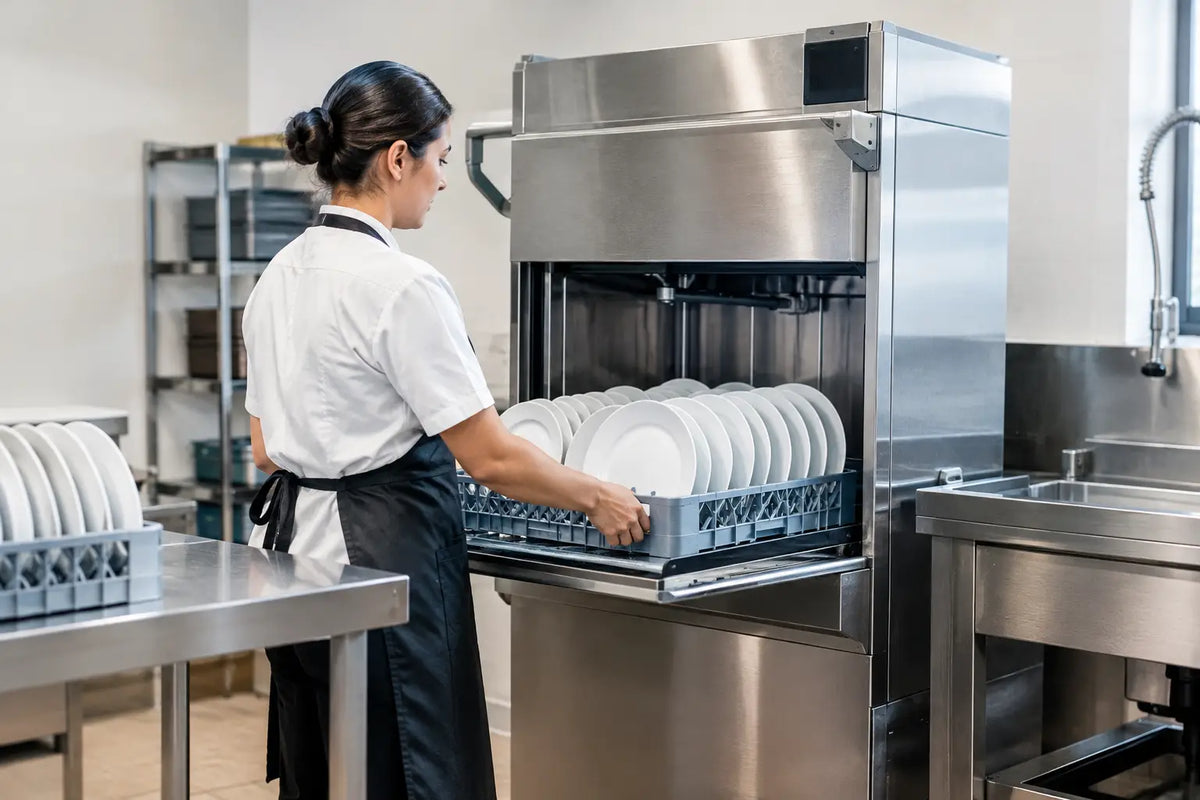
A dish machine is not simply a back-of-house convenience. When racks stack up during a lunch rush, it becomes a production bottleneck that affects table turns, labor, sanitation, and the number of clean pans available to the line. This commercial dishwashing equipment guide focuses on selecting equipment that fits actual volume, available utilities, ware types, and the way your kitchen operates under pressure.
Start With the Warewashing Load
The right machine starts with what must be washed, not with the lowest purchase price or the smallest footprint. A 60-seat quick-service restaurant, a full-service dining room, a butcher shop with processing tools, and a high-volume bakery can all have very different dishwashing requirements even when their sales are similar.
First, look at peak demand. Count racks during the busiest 30 to 60 minutes rather than estimating an average day. Consider plates, cups, utensils, hotel pans, prep containers, sheet pans, mixing bowls, and food-processing components. A meat operation may need frequent washing of grinder parts, mixer attachments, trays, and tools, while a bakery may create a steady flow of bowls, pans, and racks throughout production.
Ware size matters as much as quantity. Standard dish racks handle plates, cups, and flatware efficiently, but deep stock pots, baking sheets, bus tubs, and oversized prep equipment may require a dedicated pot sink, a higher-clearance machine, or a separate manual washing station. Forcing large wares through a machine not designed for them wastes labor and can damage both the equipment and the items being washed.
Commercial Dishwashing Equipment Guide: Main Machine Types
Commercial dish machines are built for different throughput levels and operating conditions. Each type has a practical place in foodservice.
Undercounter dishwashers
Undercounter machines fit beneath a worktable or counter and are commonly used by coffee shops, bars, small restaurants, and satellite service areas. They are compact and convenient for lower-volume glassware, dishes, and utensils.
Their main limitation is capacity. Staff must load, run, unload, and repeat each cycle, so the machine can quickly become a constraint during a busy service period. An undercounter unit can work well as a bar glasswasher or backup machine, but it may not be the best primary solution for a restaurant with rapid table turns.
Door-type dishwashers
Door-type machines, also called hood-type or upright dishwashers, are a standard choice for many full-service restaurants, catering operations, schools, and institutional kitchens. A rack slides into the machine, the operator closes the hood, and the wash cycle begins. When the hood opens, the rack is ready to move to a clean landing table.
This format offers a strong balance of footprint, speed, and labor efficiency. It supports a continuous rack flow when paired with soiled-dish and clean-dish tables. For many independent restaurants, a door-type machine provides the capacity needed for peak periods without the space and utility demands of a conveyor system.
Conveyor dishwashers
Conveyor machines are designed for sustained, high-volume warewashing. Racks move through wash and rinse sections automatically, allowing dish staff to maintain production with less stop-and-start handling. They are a practical fit for cafeterias, banquet facilities, busy hotels, hospitals, and high-volume foodservice operations.
The trade-off is substantial. Conveyor systems require more floor space, stronger utility planning, and a workflow designed around rack movement. They also make the most sense only when the operation consistently has enough volume to keep them productive. Buying a conveyor machine for occasional rushes can tie up capital and space that would be better used elsewhere.
Glasswashers and specialized machines
Bars and beverage programs often benefit from dedicated glasswashers. These units are designed for frequent cycles and glassware handling, helping bartenders keep clean glasses moving without sending every load to the main dish area.
Specialized equipment can be valuable, but it should supplement a defined warewashing plan. A glasswasher will not replace the capacity needed for plates and kitchen pans, and a standard dish machine may not be suitable for every type of delicate glassware or oversized tool.
Match Capacity to Peak Racks Per Hour
Machine specifications often list racks per hour. That number is useful, but it should not be read in isolation. A high rack-per-hour rating does not automatically mean the dish area will move faster if staff lacks space to sort, scrape, load, air-dry, and store clean wares.
Estimate your peak rack load, then build in operating margin. If a kitchen expects 35 racks during its busiest hour, choosing equipment rated near that exact number leaves little room for heavier weekends, catering orders, employee breaks, or a delayed start to dishwashing. Capacity should support the peak without requiring staff to work at an unsustainable pace.
Also review cycle length and recovery performance. Short cycles improve throughput, but the machine must maintain correct wash and rinse temperatures from one rack to the next. A unit that performs well for the first several cycles but struggles during continuous operation is not a dependable commercial solution.
Plan the Utilities Before Ordering
A dish machine purchase can fail at installation if utility requirements are treated as an afterthought. Confirm electrical service, water supply, drainage, ventilation, and floor space before selecting a model.
High-temperature machines use hot final rinse water to sanitize wares. They require adequate incoming water temperature and sufficient heating capacity to maintain the required rinse temperature during repeated cycles. Low-temperature machines typically sanitize with approved chemicals instead of high heat. They can reduce energy and hot-water demands, but they require reliable chemical dispensing, regular monitoring, and staff who understand the process.
Neither approach is automatically better. High-temperature systems can be a strong fit for operations that want heat sanitation and faster evaporation on clean wares. Low-temperature systems may be more practical where utility limitations make a high-temp installation difficult. Local health department rules and the manufacturer’s requirements should guide the final decision.
Water quality is another major operating factor. Hard water creates mineral scale on heating elements, wash arms, and glassware. It can reduce cleaning performance, increase service needs, and leave spotting on dishes. In areas with hard water, filtration or water treatment should be part of the equipment plan, not an afterthought after problems appear.
Build a Dish Area That Keeps Moving
The machine is one part of the system. A productive dish area separates dirty and clean flow so racks do not cross paths. Staff should have room to scrape, sort, pre-rinse when required, load racks, run the machine, unload, and air-dry without creating a pileup at the door.
A basic layout generally includes a soiled landing table, a pre-rinse station, the dish machine, and a clean landing table. The exact configuration depends on the room and machine type, but the purpose remains the same: reduce unnecessary steps and keep employees from carrying wet racks across the kitchen.
Choose compatible racks for plates, glasses, flatware, and specialty items. Correct rack selection protects wares and improves wash coverage. Flatware should be properly sorted and oriented according to the rack design so water reaches all surfaces. Overloading racks may look efficient, but it often causes rewashes, which consume more labor, water, chemicals, and machine time.
Compare Operating Costs, Not Just Equipment Price
The purchase price is only one part of the cost. Water use, energy consumption, chemical use, service access, replacement parts, and labor all affect the long-term value of commercial dishwashing equipment.
A less expensive unit with a slow cycle or frequent maintenance needs can cost more over time than a higher-capacity machine that reduces rewashes and labor pressure. Likewise, a large machine with excessive water and energy demand may be a poor fit for a low-volume operation. The goal is not to buy the biggest machine. It is to buy the machine that produces clean, sanitized wares at the required pace with predictable operating costs.
Factory-backed commercial equipment suppliers such as Hakka Brothers can help operators source durable kitchen systems around actual workflow needs rather than piecing together equipment from multiple general-purpose sellers.
Protect Performance With Daily Care
Commercial dish machines need routine attention to deliver consistent results. At the end of each shift, staff should remove and clean filters, check wash arms for blocked openings, drain and clean the tank as required, and inspect racks for damage. Food debris left in the machine reduces water circulation and can cause poor results on the next shift.
Managers should also verify chemical levels for low-temperature systems and monitor wash and final-rinse temperatures for high-temperature equipment. A log gives the operation a record of sanitation checks and helps identify a performance issue before it becomes a service interruption.
Train employees to recognize warning signs: cloudy glassware, food particles left on wares, weak spray pressure, water leaks, unusual noise, or repeated temperature failures. Rewashing the same racks is not a normal part of service. It is usually a signal that loading practices, chemicals, water conditions, or machine maintenance need attention.
Choose commercial dishwashing equipment as you would any core production asset. Measure the rush, verify the utilities, plan the work path, and leave enough capacity for the days when the kitchen is working hardest. A properly matched machine gives your team clean wares when they need them, without turning the dish area into the slowest station in the building.
Keep exploring
All guides ↗
How to Reduce Prep Bottlenecks in Busy Kitchens
Reduce prep bottlenecks with workflow design, right-sized equipment, cold storage, and station planning that keep commercial kitchens producing daily.
Read the guide
Salad Spinner Not Drying Lettuce? Check Your Batch
Troubleshoot unevenly wet greens with practical loading, drainage and workflow checks, plus a fact-based comparison of Clivia 10 Qt and 20 Qt manual spinners.
Read the guide
Buffet Drink Station Setup: Cups, Clearance and Refills
Plan a buffet drink station around cup clearance, guest flow and refill access, with practical checks for Hakka 3-gallon and 5-gallon dispensers.
Read the guide
Join the conversation