

THE HAKKA JOURNAL
Convection Oven Versus Combi Oven: Which Fits?
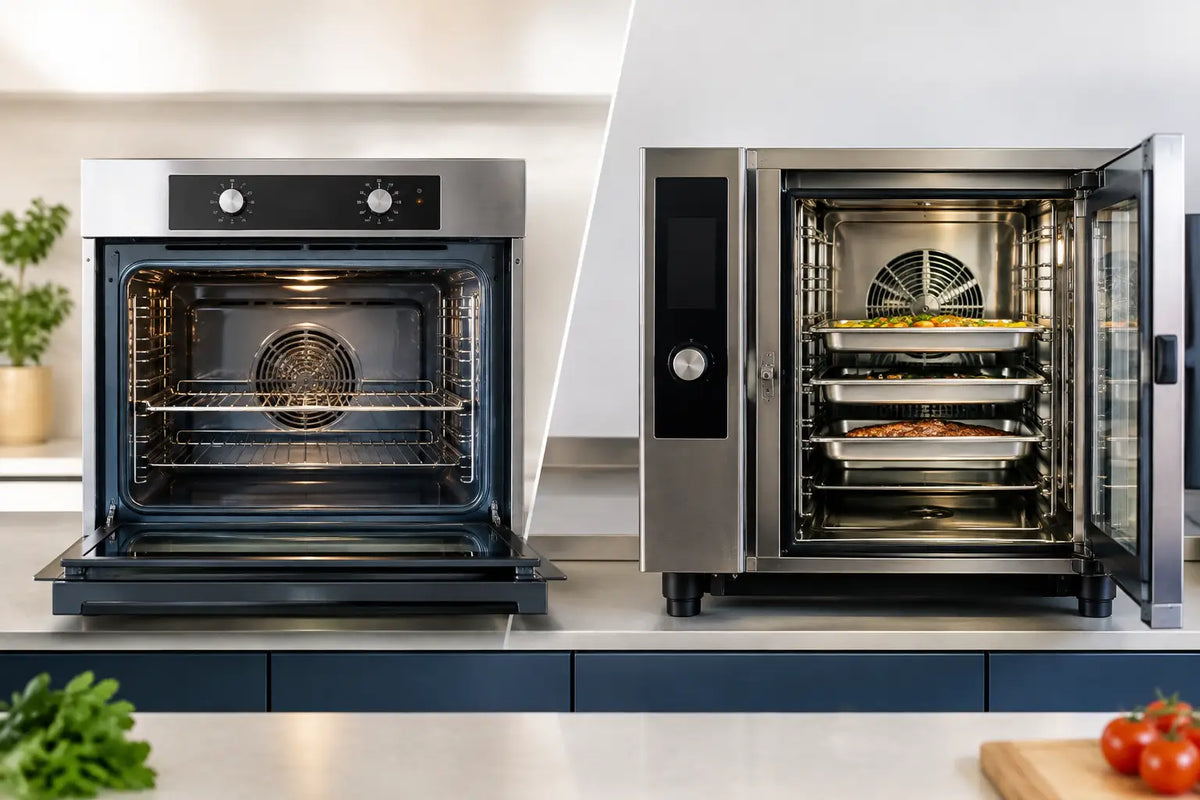
A busy lunch service exposes the real difference between a convection oven versus combi oven. One unit may produce crisp, evenly browned sheet-pan items all day. The other can roast proteins with less shrinkage, steam vegetables, regenerate plated meals, and hold tighter results across changing production volumes. The better choice is not automatically the more advanced machine. It is the oven that supports your menu, labor model, utility capacity, and daily production targets.
For restaurant operators, caterers, bakeries, BBQ businesses, and institutional kitchens, an oven purchase should be treated as a production decision. Rack capacity, pan size, humidity control, cleaning requirements, recovery time, and installation costs all affect the return on the equipment.
Convection Oven Versus Combi Oven: The Operating Difference
Both oven types use forced air to move heat around the cavity. This circulation shortens cook times compared with still-air cooking and improves consistency from rack to rack. The key difference is moisture control.
What a commercial convection oven does
A commercial convection oven uses fans to circulate dry heat. Most models are available in gas or electric configurations and commonly accept full-size sheet pans. Their straightforward design makes them a dependable workhorse for baking, roasting, reheating, and finishing.
Convection ovens perform especially well when browning and dry heat are the goal. Think roasted potatoes, baked pasta, cookies, biscuits, chicken wings, casseroles, and sheet-pan vegetables. Air movement promotes an even exterior color and helps kitchens run multiple pans with less frequent rotation.
The operational advantage is simplicity. Staff can learn the controls quickly, maintenance is generally less involved, and the initial equipment investment is usually lower than a combi oven. For a menu built around baking, roasting, and dry finishing, a convection oven often delivers the strongest value per dollar.
Its limitation is that it cannot actively add humidity. Moist foods can dry out during long cooks or repeated reheating, and delicate products may need careful timing, pan coverage, or lower temperatures to protect yield.
What a commercial combi oven does
A combi oven combines convection heat with steam generation. Depending on the model and control system, it can operate in convection mode, steam mode, or a combination mode that blends heat and humidity. Many units also provide programmable cooking stages, core-temperature probes, automatic humidity management, and wash cycles.
That range changes how a kitchen handles proteins and batch production. A combi can roast prime rib, steam broccoli, bake rolls, regenerate hotel pans, poach fish, and cook items overnight with repeatable programs. By managing moisture during the cook cycle, it can reduce protein shrinkage and help preserve texture in high-value meats.
Combi equipment is not a replacement for every piece of cooking equipment. It will not provide the open-flame flavor of a charbroiler, the high-contact sear of a griddle, or the frying performance of a commercial fryer. It does, however, consolidate several oven-based tasks into one controlled cooking platform.
Match the Oven to the Menu, Not the Feature List
The strongest case for a convection oven is a focused menu with predictable dry-heat production. A pizza shop using the oven for breadsticks and baked appetizers, a bakery producing trays of pastries, or a restaurant finishing casseroles and roasted sides may not need steam capability. A standard convection unit keeps operation direct and dependable.
A combi oven makes more sense when the menu shifts across cooking methods or when food quality depends on moisture retention. Banquet operations, hospitals, hotels, school kitchens, upscale restaurants, high-volume caterers, and commissaries can benefit from using one unit for steaming, roasting, baking, and regeneration.
Meat-focused operations should look closely at yield. A small improvement in cooked yield can become meaningful when the kitchen roasts large quantities of beef, poultry, pork, or smoked-meat sides each week. Controlled humidity can limit surface drying while allowing the product to reach the proper internal temperature. The exact result still depends on the cut, loading pattern, recipe, and operator settings, but moisture control gives the kitchen another useful lever.
Capacity Is More Than the Number of Racks
A six-pan or ten-pan rating is useful, but it is not the whole capacity story. Start by identifying the pan format your operation already uses. Full-size sheet pans, hotel pans, gastronorm pans, and bakery racks all affect loading, transfer, and labor.
Also consider what the oven is cooking at the same time. A convection oven loaded with cookies behaves differently from one loaded with deep hotel pans of potatoes. A combi oven may have the physical room for several pans, but mixed products with different temperatures, humidity needs, or cook times can still create scheduling conflicts.
For high-volume production, door openings matter. Every open door releases heat and extends recovery time. Organize production around full loads when possible, stage pans near the oven, and avoid buying a larger cabinet if the kitchen cannot support the associated electrical, gas, water, drain, ventilation, and floor-space requirements.
Installation and Operating Requirements Need a Hard Look
Convection ovens are comparatively simple to install, but operators still need to verify fuel type, voltage, phase, amperage, clearance, ventilation, and local code requirements. Gas models require the correct gas connection and may need a hood, depending on the application and jurisdiction.
A combi oven introduces more site requirements. In addition to power or gas, it typically needs a potable water connection and drain. Water quality is a major consideration. Hard water can create scale buildup, reduce performance, and increase service needs. A proper filtration or treatment plan is part of the equipment decision, not an afterthought.
Combi units also require disciplined cleaning. Their automated wash systems reduce labor, but staff still need to follow chemical, rinse, and inspection procedures. Skipping routine cleaning can affect sensors, steam generation, gaskets, and long-term reliability. A simpler convection oven has fewer systems to manage, which may be the deciding factor for a small operation with limited technical support.
Labor Savings Depend on How the Kitchen Uses the Controls
A programmable combi oven can reduce dependence on constant operator judgment. Once a tested program is set, a team can repeat a staged cook process with defined temperatures, humidity levels, fan speeds, and probe targets. This is valuable for multi-unit concepts, catering crews, and kitchens with frequent staff turnover.
But programming is only a benefit after recipes are tested and documented. A combi oven with unused advanced settings is an expensive convection oven. Operators should plan time for menu development, staff training, and standard operating procedures before expecting labor savings.
Convection ovens are easier to put into service quickly. Temperature, time, fan operation, and basic loading practices are familiar to most kitchen teams. For an independent operator who needs reliable production without adding a training burden, that simplicity has real value.
Questions to Ask Before You Buy
Before selecting either oven type, calculate the daily production load and identify the foods that create the most bottlenecks. Then confirm whether the oven will be used primarily for baking, roasting, steaming, holding, or reheating.
Ask whether moisture loss is costing the business money, whether several cooking methods need to happen in the same footprint, and whether the staff can maintain a programmable unit properly. Check the available utilities before choosing a model, not after delivery. Finally, compare the total cost of ownership: purchase price, installation, water treatment, cleaning supplies, maintenance, energy use, and expected product yield.
For a commercial kitchen that needs a durable, familiar dry-heat workhorse, a convection oven remains a practical production tool. For operations that need controlled humidity, consistent protein yield, multi-function cooking, and recipe programming, a combi oven can justify its higher cost. Hakka Brothers helps foodservice operators evaluate equipment around the work it must perform, because the right oven should improve the line every shift, not add another system for the team to manage.
Choose the unit that removes the biggest constraint in your current workflow. Better browning, more rack space, lower shrinkage, faster regeneration, or fewer pieces of equipment can all be valid goals - but the best purchase is the one your crew will use fully and profitably every day.
Keep exploring
All guides ↗
How to Reduce Prep Bottlenecks in Busy Kitchens
Reduce prep bottlenecks with workflow design, right-sized equipment, cold storage, and station planning that keep commercial kitchens producing daily.
Read the guide
Salad Spinner Not Drying Lettuce? Check Your Batch
Troubleshoot unevenly wet greens with practical loading, drainage and workflow checks, plus a fact-based comparison of Clivia 10 Qt and 20 Qt manual spinners.
Read the guide
Buffet Drink Station Setup: Cups, Clearance and Refills
Plan a buffet drink station around cup clearance, guest flow and refill access, with practical checks for Hakka 3-gallon and 5-gallon dispensers.
Read the guide
Join the conversation