

THE HAKKA JOURNAL
Manual Slicer vs Automatic Slicer for Your Kitchen
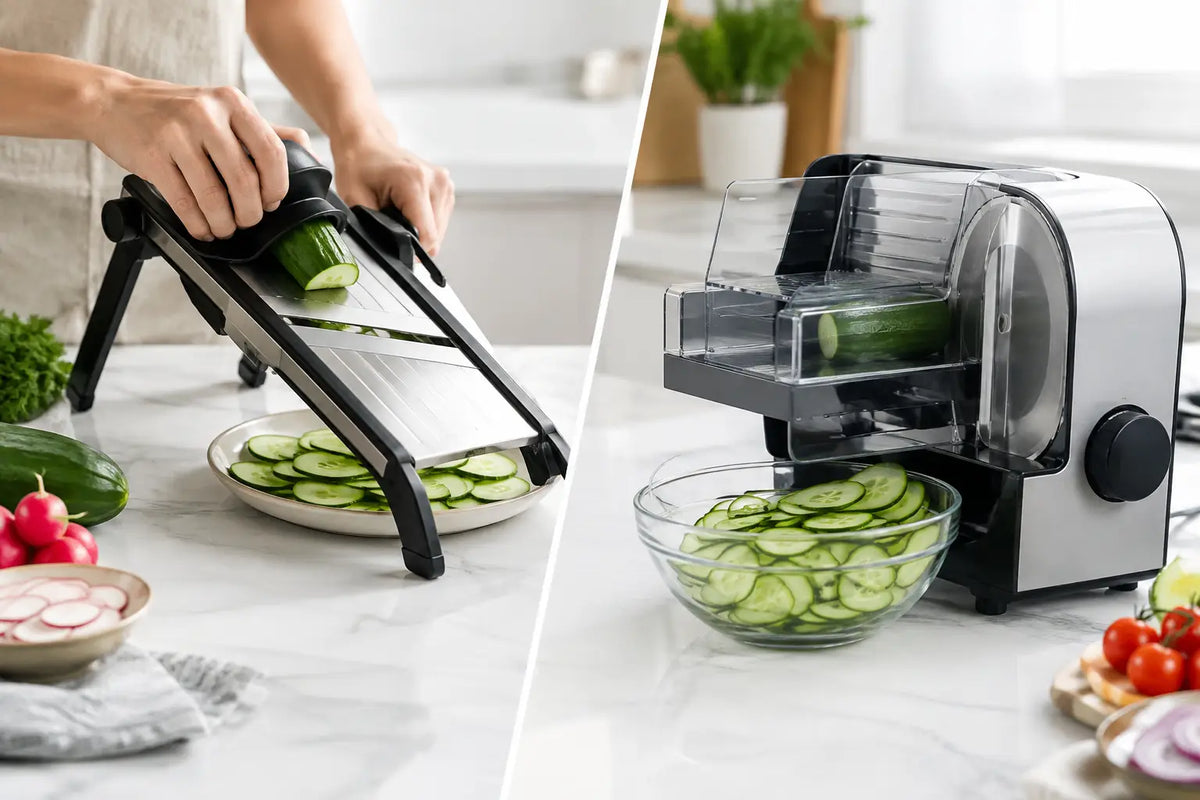
A slicer can become either a quiet prep tool or a production bottleneck. The right choice depends less on the blade diameter alone than on how many pounds of product your crew must slice, how consistently they need to do it, and whether an operator can stay at the machine. In the manual slicer vs automatic slicer decision, the best machine is the one that matches your actual workflow without adding unnecessary cost, cleaning time, or complexity.
For delis, butcher shops, sandwich programs, pizza operations, and commissary kitchens, slicing performance affects portion control, presentation, labor allocation, and product yield. A machine that is undersized for the rush can slow the entire line. One that is oversized for occasional use may not return its investment.
Manual Slicer vs Automatic Slicer: The Operating Difference
A manual slicer requires the operator to move the food carriage back and forth across the blade. The motor powers the blade, but the employee controls the pace, stroke length, and pressure. This gives the operator direct control over every slice.
An automatic slicer uses a powered carriage to move product across the blade at a selected speed. Depending on the model, the operator loads and secures the product, sets slice thickness and carriage speed, then monitors the machine as it performs repeated strokes. Some commercial units also offer manual and automatic modes, giving an operation more flexibility across different prep tasks.
The distinction matters because the carriage movement determines where labor is spent. With a manual unit, an employee remains actively involved throughout the slicing task. With an automatic unit, that employee may be able to stage pans, weigh portions, package product, or prepare the next item while the machine continues slicing.
When a Manual Slicer Is the Better Commercial Choice
Manual slicers are a practical fit for lower-volume operations and menus with varied slicing needs. A neighborhood deli may use one for ham and turkey during service, then switch to cheese or roast beef for prep. A butcher counter may need careful, hands-on control when slicing products with different textures, shapes, or firmness.
The main advantage is control. Skilled operators can adjust their carriage speed and pressure as they work, which is useful for delicate products, partially frozen meats, irregular cuts, and smaller batches. They can also stop immediately to reposition the product, inspect slice quality, or change thickness for a new order.
Manual machines generally have a simpler operating system and lower upfront cost than comparable automatic models. For a cafe, small restaurant, mobile caterer, or specialty shop that slices only a limited amount each day, this can be the more sensible investment. Paying for automation makes less sense if the slicer sits idle for long periods.
A manual slicer also works well when slicing is an order-driven task rather than a dedicated prep function. If one team member slices a few portions of cheese, salami, or cooked meat at a time, direct carriage control can be faster than setting up an automatic cycle.
That said, manual operation has a clear labor limit. Repetitive carriage movement becomes tiring over long prep periods. Slice consistency can also vary between employees, especially when the team is rushed or less experienced. Those issues become more noticeable as daily production rises.
Best applications for manual slicers
Manual slicers are usually well suited to operations with moderate output, frequent product changes, and a need for hands-on control. They are commonly used for made-to-order sandwiches, small deli counters, restaurant prep, specialty cheese programs, and butcher shops handling varied cuts.
When an Automatic Slicer Pays for Itself
Automatic slicers are built for repetition. If your staff spends a significant part of each day slicing the same products into uniform portions, automation can reduce labor strain and improve production consistency.
Consider a high-volume sandwich shop that slices multiple logs of turkey and ham before lunch, a pizzeria that portions large quantities of pepperoni, or a commissary producing packaged deli meat for several locations. In these settings, a powered carriage keeps the slicing cycle moving at a predictable rate. The operator can focus on product loading, pan changes, quality checks, and packaging instead of making every carriage stroke by hand.
Consistency is another major benefit. Once thickness and carriage speed are correctly set, an automatic slicer can produce more uniform slices across a large batch. That supports portion control, improves the appearance of retail packs and plated food, and helps control food costs. Thin-sliced product is especially sensitive to inconsistency because a small variation in slice thickness can add up over dozens of portions.
Automatic units can also reduce physical fatigue. This does not eliminate the need for trained staff, safe loading procedures, or active supervision. It does mean the operation is less dependent on repetitive manual motion during long production runs.
The trade-off is higher initial cost and, in many cases, more components to understand and maintain. Automatic slicers are not automatically the right answer for every kitchen. If your operation slices only a few pounds at a time or constantly changes between products and thickness settings, the extra automation may provide limited value.
Compare Output, Labor, and Product Mix
The simplest way to choose is to measure your real prep demand. Track the product types being sliced, pounds processed per day, longest continuous slicing run, desired slice thickness, and number of employees assigned to prep. Estimates based on a single busy day can lead to the wrong machine size. Review a typical week, including peak production days.
A manual slicer often makes sense when batches are short and product changes are frequent. The operator can transition quickly from a thick-cut roast beef order to thin-sliced provolone without relying on a long automatic run to justify setup time.
An automatic slicer becomes more compelling when batches are larger and more repetitive. If a prep employee spends an hour manually slicing the same product every morning, a powered carriage can free up meaningful labor capacity. The value is not just speed. It is the ability to keep production moving while staff handle adjacent tasks.
Product characteristics should also guide the decision. Firm, chilled deli meats and cheeses are common automatic-slicing applications because they move through repeated strokes predictably. Irregular, soft, or delicate items may require more operator attention. Proper product temperature remains essential regardless of slicer type. Product that is too warm can tear, compress, or stick, while overly frozen product can damage the blade or create poor slice quality.
Blade Size and Construction Still Matter
Automation is only one part of slicer selection. Blade diameter determines the size of product the machine can handle. A larger blade can accommodate bigger loaves, large deli logs, and wider cuts, but it also requires more counter space and may be unnecessary for a compact menu.
Look for commercial-grade construction suited to your usage level. A stable base, durable carriage, reliable thickness adjustment, product pusher, blade guard, and accessible sharpener all affect daily performance. Food-contact surfaces should be easy to clean, and controls should be positioned for safe operation.
For operations processing meat regularly, selecting equipment designed for professional foodservice use is more practical than relying on consumer-grade units. Hakka Brothers focuses on commercial meat-processing equipment because prep machinery must hold up under repeated service and production demands.
Cleaning and Safety Are Part of the Purchase Decision
Every slicer creates a sanitation responsibility. Meat residue, cheese oils, and food particles can collect around the blade, carriage, gauge plate, and guards. A machine that is difficult to access or clean will cost time at closing and increase the risk of poor sanitation practices.
Train employees to power down and unplug the machine before cleaning, set the thickness control to zero when the slicer is not in use, and follow the equipment manual for disassembly and sanitation. Cut-resistant gloves and proper tools should be used where appropriate. Never treat an automatic carriage as a substitute for safe handling. The blade remains the primary hazard, whether the carriage is moved by hand or motor.
Before purchasing, consider who will clean the slicer and how often. A model with clear access to key areas can support better daily habits than one that is technically capable but difficult for the team to maintain.
Make the Decision Based on the Next Busy Shift
Choose a manual slicer when your menu requires flexibility, your batches are limited, and a trained employee can stay at the machine without slowing other work. Choose an automatic slicer when repeated, high-volume slicing is consuming labor and consistent output has a direct effect on margins or service speed.
The useful question is not which slicer is more advanced. It is whether the machine will keep pace when orders stack up, prep time is short, and every pound of product needs to be sliced safely and consistently.
Keep exploring
All guides ↗
How to Reduce Prep Bottlenecks in Busy Kitchens
Reduce prep bottlenecks with workflow design, right-sized equipment, cold storage, and station planning that keep commercial kitchens producing daily.
Read the guide
Salad Spinner Not Drying Lettuce? Check Your Batch
Troubleshoot unevenly wet greens with practical loading, drainage and workflow checks, plus a fact-based comparison of Clivia 10 Qt and 20 Qt manual spinners.
Read the guide
Buffet Drink Station Setup: Cups, Clearance and Refills
Plan a buffet drink station around cup clearance, guest flow and refill access, with practical checks for Hakka 3-gallon and 5-gallon dispensers.
Read the guide
Join the conversation